Get Found When Customers Stop Typing—And Just Ask Their Phone
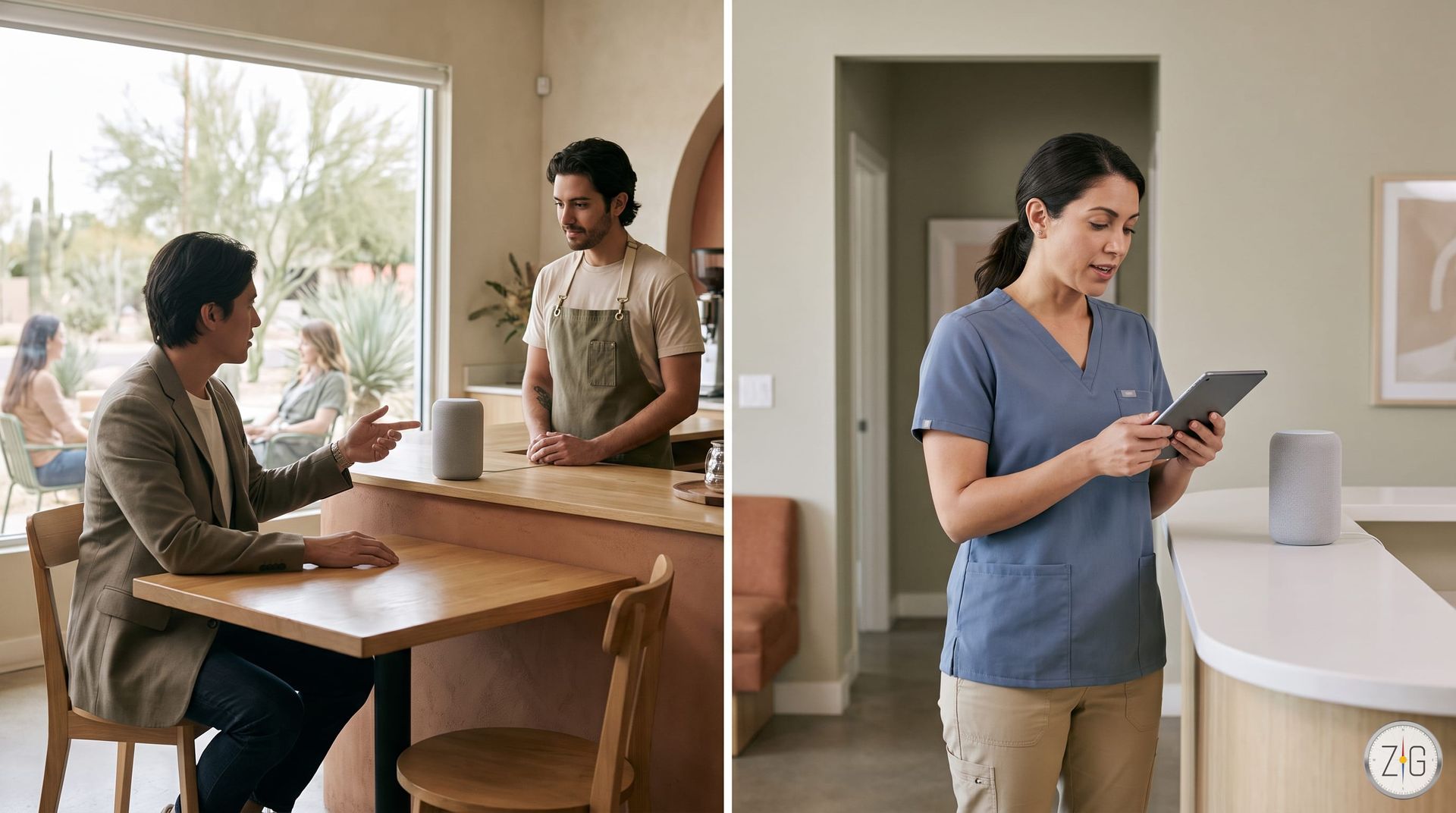
Picture this: a couple lands at Phoenix Sky Harbor, drops their bags at a hotel in Old Town, and one of them says, "Hey Siri, find a good sushi place near me." Siri answers with one name. Not yours.
That moment — three seconds, one spoken question, zero browser tabs opened — is now how a meaningful share of dining and healthcare decisions get made in Scottsdale. According to Invoca (citing BrightLocal), 51% of voice search users research restaurants via voice assistants before deciding where to eat. Healthcare isn't far behind — Yaguara reports the same 51% figure for health and wellness searches. These aren't hypothetical future customers. They're here, asking out loud, right now.
Voice search is the local discovery channel where the decision happens before the browser opens.
And according to QuoteFlow Marketing (citing BrightLocal), 76% of those local voice searches result in a same-day visit. This isn't top-of-funnel awareness traffic. It's a customer who is ready to show up.
This guide breaks down exactly how AI assistants decide who gets recommended — and what Scottsdale restaurant owners and medical practice managers can do about it today, not next quarter.
So How Does Voice Search Actually Decide Who Gets Recommended?
Voice search is not a black box. It is a retrieval system, and it pulls from four specific data layers: your Google Business Profile, your reviews, your website content, and third-party platform signals like Yelp and Foursquare. Get those layers right, and the algorithm has what it needs to surface you. Leave gaps, and it picks someone else.
The first thing to understand is that voice queries are structurally different from typed searches. According to Digital Applied, the average voice search query is 29 words long, compared to just 3–4 words for a typed search. Nobody says "Italian Scottsdale." They say "What's a good Italian restaurant open right now near Old Town Scottsdale?" Your content either answers that full question or it doesn't. Keyword-stuffed pages written for typed searches fail this test structurally — they are not built to answer a sentence.
The second layer is your business data. According to Synup, citing the Uberall Voice Search Readiness Report, businesses with a complete Google Business Profile are 70% more likely to attract voice search queries. That is not a small edge — that is the difference between existing in the system and being a ghost in it.
As Josh Kopel, Restaurant Marketing Strategist, puts it: "You get recommended when three things are true: your core facts are identical everywhere they appear, your website answers the actual question in language a machine can extract, and other credible sites mention you by name." That is the entire framework. NAP consistency, conversational content, and third-party citations. Three things.
The third layer is reviews — and not just the star rating. AI assistants scan review text for keywords, recency, and response patterns. A business with 200 recent reviews mentioning "gluten-free options" or "same-day appointments" gives the algorithm something to match against a spoken query. A business with 11 reviews from 2019 gives it nothing useful.
There is no magic. There is only structured, complete, consistent information that a machine can read and trust. That is the game.
Your Google Business Profile: The Loudest Thing AI Can Hear
Your Google Business Profile is not a listing. It is a data feed that AI assistants parse in milliseconds to decide whether you are worth recommending. According to Synup, businesses with a complete Google Business Profile are 70% more likely to attract voice search queries. Incomplete profiles do not get partial credit — they get skipped.
The fields that matter most are not the flashy ones. Business name, primary category, hours, phone number, and services. These are the facts a voice assistant reads out loud when someone asks "Is there a dermatologist near me open today?" If your hours are wrong or your category is vague, the AI moves on to the next result. Your competitor gets the call.
The Q&A section on your profile is one of the most underused fields in local search. According to MEAN CEO Blog(citing Digital Applied), 70% of voice queries are phrased as complete questions — not keyword fragments. Populating your Q&A with the exact questions your customers are already asking is essentially pre-loading the answer the AI will read back to them.
There is also a platform most Scottsdale business owners forget entirely: Yelp. According to Improvado, Siri pulls local business information directly from Yelp — not Google — when responding to voice queries. If your Yelp profile is incomplete, outdated, or unclaimed, you are invisible to every iPhone user asking for a recommendation out loud.
The businesses that wonder why no one calls have one thing in common: a profile that was set up in 2021 and never touched again. Outdated hours, a missing phone number, zero photos, and a category that says "restaurant" when you need it to say "sushi restaurant." Fix the data. AI can only recommend what it can read clearly.
Reviews Aren't Just Good for Your Ego — AI Is Reading Them Too
If your business is sitting on 11 reviews from 2019, congratulations — you have a digital artifact, not a competitive asset. AI assistants use review quantity, recency, star rating, and the actual language inside reviews to decide who gets recommended out loud. That last part is the one most business owners miss entirely.
According to SOCi's Local Visibility Index, locations recommended by ChatGPT average a 4.3-star rating, and locations recommended by Perplexity average 4.2 stars. That is not a coincidence. Star rating is a gating threshold — fall below it and the algorithm does not care how good your food is or how many years you have been open.
Review content matters just as much as review count. When a patient writes "found this dermatologist on a Sunday when I needed urgent care in Scottsdale," that sentence does more SEO work than most business owners realize. It plants conversational, location-specific language directly inside a trusted third-party source — exactly the kind of signal AI pulls when constructing a spoken recommendation.
As Josh Kopel, Restaurant Marketing Strategist, puts it: "Review replies are a publishing channel that machines read. This is a five-minute fix most operators never make." Responding to reviews is not just good manners. It creates indexed, keyword-rich content that reinforces your business's relevance to specific queries.
The fix is not complicated. Ask every satisfied customer for a review — directly, specifically, right after the positive experience. Set a weekly reminder to respond to every review that comes in. And if your last review predates a presidential election, treat that as an emergency, not a to-do list item.
Talk the Way Your Customers Talk: Conversational Keywords for Voice Search
Nobody says "Italian restaurant Scottsdale" out loud. They say, "What's a good Italian restaurant open right now near Old Town Scottsdale?" That's not a trivial difference — it's a completely different keyword universe, and most business websites are optimized for the first version while their customers are speaking the second.
According to Digital Applied, the average voice search query is 29 words long, compared to just 3–4 words for a typed search. Your homepage that leads with "Authentic Italian Cuisine | Scottsdale, AZ" is essentially invisible to that spoken question.
This matters more in Scottsdale than almost anywhere else. According to Signals AZ(citing the City of Scottsdale Tourism & Events Division), the city welcomed over 11 million visitors in 2024 — millions of them arriving without restaurant reservations, asking their phones what to do for dinner. Old Town alone has 90+ restaurants competing for that spoken question. The business whose website answers it wins.
The fix is not complicated. Audit your FAQ page and website copy for short, fragmented keyword phrases and replace them with full questions your customers actually ask:
- Instead of: "Open for lunch" → Write: "What are your lunch hours on weekdays?"
- Instead of: "Accepts new patients" → Write: "Are you accepting new patients in Scottsdale right now?"
- Instead of: "Gluten-free options" → Write: "Do you have gluten-free menu options in Old Town Scottsdale?"
As the Lureon.ai team puts it: "The shift from keyword-focused SEO to conversational, context-aware content is the most significant change since mobile-first indexing." Your FAQ page isn't just for users anymore — it's feeding answers directly to voice assistants.
According to Scottsdale SEO Company, 67% of restaurant searches happen within one hour of the dining decision. These people aren't browsing — they're deciding. The website that answers their spoken question in plain, complete language gets the click. Write for the voice, not the keyboard.
Restaurants: What AI Assistants Want to Know Before Recommending You
According to Local Falcon's analysis of 189,905 ChatGPT results, 83% of restaurants do not appear in ChatGPT local recommendations at all. Compare that to only 14% invisible on Google. That gap is not a glitch — it's a data problem. AI assistants cannot recommend what they cannot confidently describe.
Here is what they are actually checking before they say your name out loud:
- Hours — current and accurate. If your Tuesday hours are wrong on Yelp, you are not getting recommended for Tuesday dinner.
- Cuisine type and price range. "Affordable sushi near Old Town" is a query your listing either answers or doesn't.
- Reservations availability. This one just got more important. On August 10, 2026, ChatGPT launched in-chat reservations through OpenTable, Resy, and Yelp — per TechJack Solutions citing OpenAI's release notes. If your restaurant is not listed on at least one of those platforms, you are not just missing a recommendation — you are missing the booking entirely.
- Star rating. SOCi's 2026 Local Visibility Index found that locations recommended by ChatGPT average a 4.3-star rating. Below that threshold, the algorithm moves on.
- Accessible menu data. A PDF menu is invisible to AI. Text-based menu content on your website or Yelp profile is not.
As Josh Kopel, restaurant marketing strategist, puts it: "You get recommended when three things are true: your core facts are identical everywhere they appear, your website answers the actual question in language a machine can extract, and other credible sites mention you by name."
Culver's proved this works at scale — 100% Google Business Profile completeness and a 4.4-star average earned them a 30% ChatGPT recommendation rate, roughly six times the industry benchmark, per SOCi. Papa John's, with only 67.4% profile accuracy, received zero recommendations from ChatGPT, Gemini, or Perplexity. Zero.
The checklist is not complicated. The execution is what most restaurants skip.
Medical Practices: How Patients Are Finding You (Or Not) With Their Voice
Patients do not search for doctors the way they search for shoes. They search with urgency. "Is there an urgent care in Scottsdale open right now?" "Find a dermatologist near me accepting new patients." "Which cardiologist takes Blue Cross near Old Town?" These are not keyword fragments — they are full questions spoken out loud to a device, and if your practice's listing cannot answer them cleanly, AI moves on to the next result.
According to Top Doctor Magazine, practices that rank well in traditional SEO but remain absent from AI-generated responses and voice search results are effectively invisible to a growing patient segment. That is not a future problem. It is a current one.
Here is what AI actually needs to surface your practice: your accepted insurance plans stated explicitly, your conditions treated listed by name (not buried in PDF brochures), your hours — including whether you take walk-ins on weekends — and your new patient availability status. These are not nice-to-haves. They are the exact data points a voice query is trying to resolve.
According to MedResponsive, business listings with complete information receive 3.2 times greater voice search visibility than incomplete profiles. Most medical practice listings are incomplete. Half-filled profiles with no insurance data, no specialty descriptions, and hours that have not been updated since 2022 are the norm — and the AI skips right past them.
The PracticeBeat editorial team put it plainly: voice assistants return one answer , not a ranked list. Being the fifth-best-optimized dermatology practice in Scottsdale is the same as being invisible.
Schema Markup: The Boring Technical Thing That Makes a Big Difference
Schema markup is structured data — a layer of code you add to your website that tells AI assistants and search engines exactly what your business is, what you do, and where you do it. Not in human language. In machine language. And that distinction matters more than most business owners realize.
According to WiseRoots LLC, Scottsdale's local search market is already hypercompetitive across restaurants, healthcare, and professional services. Schema markup is one of the few technical levers that lets a smaller independent business communicate with AI systems at the same precision level as a national chain with a 20-person marketing team.
There are three schema types that matter most for this audience:
- LocalBusiness schema — name, address, phone, hours, geo-coordinates. The baseline.
- Restaurant schema — adds cuisine type, price range, reservation links, and menu URL. All signals AI assistants use to match a voice query like "find me a sushi place open right now."
- MedicalClinic schema — includes accepted insurance, medical specialty, and availability. The fields a patient is effectively asking about out loud before they ever pick up the phone.
You do not need to learn HTML. You need to ask your web developer one question: "Do we have LocalBusiness schema implemented, and is it accurate?" If they hesitate, you have your answer.
The Scottsdale Advantage: Why Local Optimization Beats Broad Every Time
National chains have bigger budgets. They do not have your zip code, your neighborhood context, or your ability to out-optimize them on hyper-local signals — and in voice search, that gap is exploitable.
Voice queries are inherently local. When someone says "find me a dermatologist accepting new patients near McCormick Ranch" or "best patio restaurant in Old Town," the assistant isn't ranking national brand authority. It's ranking proximity, profile completeness, and conversational content relevance. Those are things a local operator can win on.
According to WiseRoots LLC, Scottsdale's market combines a high-density competitive landscape with a tourism layer that floods search with transient, intent-heavy queries — visitors who have no brand loyalty, no prior knowledge of the market, and are making decisions in real time by asking their phones. That is not a threat to a well-optimized local business. That is a gift.
The Scottsdale restaurant or practice that references its neighborhood, uses the language its actual patients and diners use, and keeps every data point consistent across Yelp, Google, and OpenTable is going to beat a national chain with a generic profile every time a voice assistant returns one answer — because it will be the one answer.
This is a winnable game. The window to win it first is right now.
Voice search and AI assistants are not coming for your customers — they are already talking to them. According to Studio Meyer, only 45% of businesses that rank well on Google also appear in AI-generated answers, which means the digital presence you have been building may be missing half the game entirely.
The mechanics are not complicated. Google Business Profile accuracy, review recency, structured website content, and Yelp completeness are the signals AI assistants use to decide who gets spoken out loud. As the Localogy editorial team put it plainly: businesses not optimizing for conversational, AI-powered search may not appear when someone asks "What's the best Italian restaurant nearby?" That question is being asked thousands of times a day in Scottsdale — and someone is getting that recommendation.
The good news is this is a solvable problem. Complete your profiles. Earn fresh reviews. Structure your content around full questions, not keyword fragments. Get your schema implemented. Be on Yelp. These are not moonshot strategies — they are the same fundamentals as good local SEO, just applied with a voice-first lens.
The window to move first in Scottsdale is still open. Not for long.
Ready to find out where your business actually stands? Schedule a free local SEO audit with Zack Greenfield and find out exactly how visible your Scottsdale business is to voice search and AI recommendations — before your competitor figures it out first.
Frequently Asked Questions
How does voice search decide which local business to recommend?
Voice assistants pull from Google Business Profile data, review signals, website content, and third-party platforms like Yelp and Foursquare to generate a single spoken recommendation. According to BrightLocal via QuoteFlow Marketing, 76% of local voice searches result in a same-day visit, making profile accuracy and content quality directly tied to foot traffic.
What is the most important thing a Scottsdale restaurant can do for voice search?
Claim and fully complete your Google Business Profile and your Yelp listing — both of them, not just one. According to TechJack Solutions, ChatGPT now books restaurant reservations directly through OpenTable, Resy, and Yelp, meaning a missing or incomplete Yelp profile removes you from the AI booking loop entirely.
Do medical practices in Scottsdale need to worry about voice search?
Yes — and sooner than most practice managers expect. According to Top Doctor Magazine, over 70% of health-related queries now result in zero-click searches where patients get answers from AI without ever visiting a practice website. If your listing information is incomplete or your website does not answer common patient questions in plain language, you are not being considered.
Is Google SEO the same as voice search optimization?
No, and conflating the two is an expensive mistake. According to Plattio citing SOCi, only 45% of businesses that win on Google also appear in AI-generated answers — meaning strong Google rankings do not guarantee voice or AI visibility. They require overlapping but distinct optimization strategies.
How do reviews affect voice search recommendations?
Star rating is a structural eligibility threshold for AI recommendations, not just a reputation metric. According to SOCi's Local Visibility Index, businesses recommended by ChatGPT average a 4.3-star rating and those recommended by Perplexity average 4.2 stars — meaning falling below that threshold effectively removes you from the candidate pool before any other factor is considered.