One Recording, 30 Days of Content—No Camera Required
Most Scottsdale business owners already know they need video content. They also have a folder full of footage they recorded and never posted. According to HeyGen's State of AI Avatars 2026 — a survey of 1,000+ small business owners — 71.6% recorded a video and decided not to post it . And 55.6% of those same owners admitted they lost business to a more visible competitor.
That is not a technology problem. That is a camera-anxiety problem wrapped in a production-complexity problem wrapped in a time problem. AI avatar video solves all three at once.
AI avatar video marketing lets a business owner record once, build a digital spokesperson from that footage, and generate weeks of professional video content from text scripts — no camera, no crew, no re-filming required.
Meanwhile, Pictory's AI Video Statistics report found that 78% of marketing teams are already using AI-generated video in at least one campaign per quarter. This is no longer experimental. It is infrastructure. And Scottsdale service businesses that keep treating video as a production event instead of a content system are going to feel that gap widen fast.
This guide is the no-fluff roadmap to fixing that.
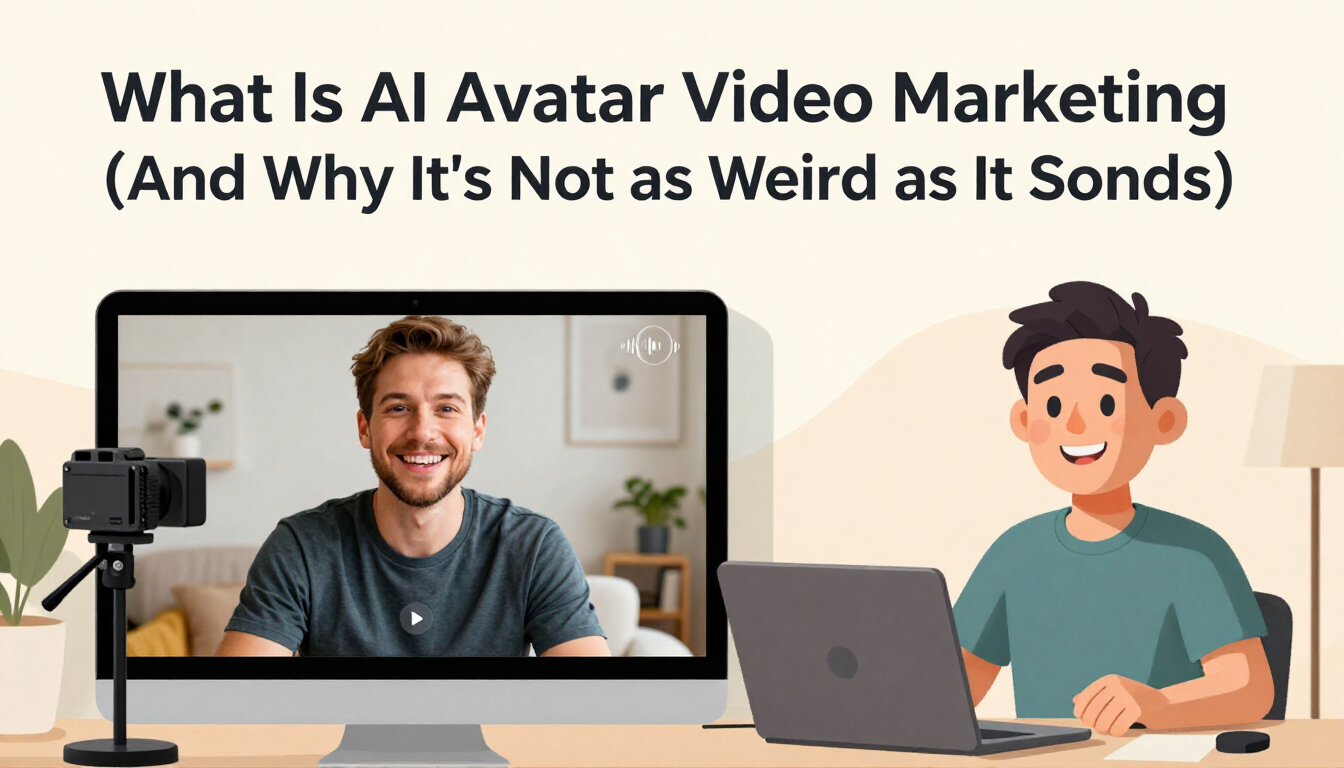
What Is AI Avatar Video Marketing (And Why It's Not as Weird as It Sounds)
AI avatar video marketing is simpler than the name suggests. You record yourself once — talking naturally, on camera, for about 30 to 60 minutes. That footage trains a digital version of you. After that, you never have to film again. You write a script, the avatar delivers it, and you have a finished video in minutes.
No studio. No ring light. No "wait, let me redo that take." Just text in, video out.
The technology is not new — it has just gotten fast and cheap enough for small businesses to actually use. According to Pictory.ai's AI Video Statistics, text-to-video generation produces content in under five minutes for clips under 10 minutes. The same content through traditional video production takes an average of four to six hours. That is not a marginal efficiency gain — that is a different category of tool.
The market reflects it. The AI avatar market was valued at $6.06 billion in 2024 and is projected to grow at a 40.8% CAGR through 2030, according to the same Pictory.ai data. Platforms like HeyGen — which has crossed $205 million in annual recurring revenue and serves over 85,000 customers — were built specifically for small businesses, not enterprise IT departments.
As Sacra Research noted in their analysis of HeyGen's growth, the platform won by making AI avatar video "feel like a cheap, fast everyday software tool instead of a procurement decision." That is exactly what this technology is in 2025: an everyday tool, not a science project.
The skepticism is understandable. Early deepfakes were unsettling. Modern AI avatars are not that — they are polished, professional, and increasingly indistinguishable from a standard talking-head video. If you have watched a LinkedIn video this week, there is a reasonable chance you already saw one.
Why Scottsdale Service Businesses Can't Afford to Skip Video Anymore
Scottsdale is not a forgiving market. Hibu's local market analysis describes it as a highly competitive small business environment with an educated customer base and year-round consumer demand — which means your competitor showing up consistently in someone's feed while you don't is not a minor disadvantage. It's a slow bleed.
Short-form video is now the highest-ROI content format available, ranked number one by 49% of marketers and generating 2.5x more engagement than long-form content on social platforms, according to Review42's social media marketing statistics citing Sprout Social and HubSpot data. That gap between video and everything else isn't closing — it's widening every quarter the platforms keep rewarding it algorithmically.
The repurposing math makes this even harder to ignore. According to INDIRAP, one 10-minute video can generate 30+ derivative content pieces — Reels, Shorts, blog posts, newsletters, quote graphics. LTL Creative puts it more bluntly: a single five-minute video can produce 15 to 20 unique assets, increasing total content output by 300–500%.
For a Scottsdale restaurant posting weekly specials or a medical practice answering patient FAQs, that is not a content strategy — that is infrastructure. And right now, most of your local competitors haven't figured that out yet.
That window won't stay open long.
The One-Recording Workflow: How to Turn a Single Session Into 30 Days of Content
This is a system, not a production event. One 60-minute recording session becomes the raw material for an entire month of video content — and once your avatar is trained, you never have to record again unless you want to.
Here is exactly how it works:
Step 1: Record Your Source Session (Once)
Sit in front of a decent camera — your phone works — and record 10 to 20 minutes of natural talking. No script required. Cover your expertise: answer common questions, share your process, give your opinion on something in your industry. This is the footage that trains your AI avatar to look, sound, and move like you.
Step 2: Train the Avatar
Upload the recording to a platform like HeyGen. The system analyzes your facial movements, voice, and cadence, then builds a digital version that speaks whatever text you feed it. The result is indistinguishable from a re-shoot — without the re-shoot. According to Luma AI's AI Video Generation Statistics, 63% of video marketers used AI tools to create or edit video in 2025, up from 51% in 2024. This is not fringe technology anymore.
Step 3: Write Scripts for Every Content Type
This is where the leverage lives. Take one topic — say, "three things to ask before hiring a contractor" — and write five different versions: a 60-second Reel, a 30-second Short, a LinkedIn post with talking-head video, an email newsletter intro, and a blog post pull quote. Same idea, five assets, zero additional camera time.
As the INDIRAP editorial team puts it, "repurposing video content effectively means transforming one core piece into 10+ derivative assets across different platforms and formats, each optimized for specific audience behaviors and platform algorithms." That is not a creative strategy — that is an operational one.
Step 4: Generate and Distribute
Feed each script into the avatar platform. A sub-10-minute video generates in under five minutes, according to Pictory.ai's AI Video Statistics. Traditional production takes four to six hours for the same output. At that ratio, one session produces enough content to post three to five times per week — which is exactly the frequency that research shows drives 2 to 4 times more profile visits for local businesses.
The Math Is Not Subtle
One recording session. One trained avatar. Thirty-plus pieces of content. The only thing left is distribution — and that is where a managed workflow beats a DIY attempt every time.
Real-World Use Cases: Restaurants, Medical Practices, and Local Service Businesses
Abstract advice about "repurposing content" means nothing until you can see it working in a business that looks like yours. So here is what this actually looks like across three industries where showing up consistently on video is the difference between a full calendar and an empty one.
Restaurants: 30 Days of Content From One Afternoon
A restaurant owner does not need a new video idea every day. They need a system. One recording session — the owner or a spokesperson talking through five or six core topics — produces enough avatar video scripts to cover an entire month.
Week one: a Monday special preview, a "how we make our signature dish" clip, and a staff intro. Week two: a customer review callout, a seasonal menu spotlight, and a behind-the-scenes kitchen moment with voiceover. Week three: a "did you know we do catering?" explainer. Week four: repeat the highest-performer from week one with a refreshed script. That is a posting cadence of 3–5 short-form videos per week — which, according to Monolit's Short-Form Video for Business Guide, is the frequency at which local business owners see 2–4x more profile visits compared to those posting only images or text.
No chef has to stop mid-service to perform for a camera. The avatar handles it.
Medical Practices: FAQ Once, Educate Forever
A medical practice has one content asset hiding in plain sight: the questions patients ask at every single appointment. Record the provider answering 10 of them once. That becomes 10 patient education videos, 10 social clips, and 10 email sequences — all HIPAA-compatible because no patient information is involved.
According to D-ID, AI avatar video for healthcare can deliver patient education and answer routine questions consistently, while diagnosis and care decisions stay with clinicians — which keeps it squarely in compliant territory. Think: "What to expect at your first consultation," "How to prepare for your procedure," "Why we recommend annual screenings." Content that builds trust before the patient ever walks in the door.
Local Service Businesses: Authority Without the Ego
For a plumber, landscaper, or home services contractor, being on video feels uncomfortable — and according to Sendspark, camera shyness affects 35% of people who want to create video content. That is not a character flaw. That is a production problem. An AI avatar removes it entirely.
A service business owner records once, builds their avatar, and then publishes weekly "pro tips," seasonal checklists, and before/after project breakdowns — without ever needing to look presentable again on a Tuesday morning. That consistent presence is what builds authority in a competitive local market. Visibility creates trust before the first phone call happens.
Busting the Myths: What AI Avatar Video Marketing Is NOT
Let's kill the objections that are keeping you stuck, because most of them are based on 2017 technology and 2017 assumptions.
Myth #1: "It'll look like a cheap deepfake."
It won't. The uncanny-valley era of AI video is largely over. Sacra's market analysis of HeyGen noted the platform "won early by making AI avatar video feel like a cheap, fast everyday software tool" — meaning the production quality crossed the believability threshold years ago. Synthesia counts over 60% of Fortune 100 companies as customers, according to Luma AI's AI Video Generation Statistics. Those companies have legal teams. They are not posting content that looks like a ransom note.
Myth #2: "I need to be a tech person."
HeyGen starts at $24/month with a free tier. According to Jatinder Purewal's HeyGen case study, the platform's core users are estate agents, personal trainers, and online course instructors — not developers. If you can write an email, you can run this workflow.
Myth #3: "It'll make me look inauthentic."
Your avatar is trained on you — your voice, your mannerisms, your face. It amplifies your presence instead of replacing it. The alternative — posting nothing because the camera makes you nervous — is what actually kills authenticity. Silence is not a brand strategy.
Myth #4: "This is enterprise-only technology."
Wrong decade. The GigWise editorial team, citing an IAB report, put it plainly: "Small and mid-tier brands are adopting faster than the biggest spenders — the cost savings hit hardest when you never had a production budget to begin with." That's the Scottsdale restaurant owner and the local med spa, not just the Fortune 500.
What to Look for (and What to Avoid) When Getting Started with AI Video
Not every AI video tool — or agency selling AI video services — is built for a local service business. Some are built for enterprise training departments. Some look impressive in a demo and fall apart in production. Knowing the difference before you spend a dollar matters.
Green flags to look for:
- A workflow, not just a tool. The goal isn't to hand you a platform login. It's to build a repeatable system. According to Monolit, local businesses posting 3–5 short-form videos per week see 2–4x more profile visits than those posting only images or text. That frequency requires a system, not a one-time effort.
- Industry-specific thinking. A restaurant owner and a medical practice owner have completely different content needs. D-ID's analysis of AI avatar use cases specifically notes that healthcare AI video works best for patient education and FAQ content — areas with no PHI involved — not clinical explanations. Generic advice skips that nuance entirely.
- Realistic expectations upfront. Anyone promising viral results from week one is selling you something.
Red flags to walk away from:
- Agencies that can't show you real output from real client accounts — not polished demo reels.
- Tools that require a full production setup to train the avatar. The whole point is reducing that friction.
- Anyone who can't explain the repurposing strategy. Generating videos is the easy part. Distributing them intelligently across platforms is where most people leave money on the table.
Scottsdale's market is unforgiving about this. According to Hibu, it's a highly competitive small business environment with an educated consumer base that spots low-effort marketing immediately. Your execution has to match your market.
Why Scottsdale Businesses Are Choosing to Work With a Local Marketing Partner on This
AI avatar video is not complicated to understand. It is complicated to execute consistently — and consistency is the whole game. According to Monolit's Short-Form Video for Business guide, founders posting 3–5 short-form videos per week see 2–4x more profile visits than those posting only images or text. That cadence does not happen by accident. It happens because someone built a system and shows up to run it.
Most Scottsdale business owners have enough on their plates without becoming their own video production department. The technology is accessible. The strategy is proven. The gap is execution — and that is exactly where a local partner closes the loop.
A local agency brings something a DIY tool never will: knowledge of this specific market. The Scottsdale customer is educated, comparison-shops aggressively, and responds to social proof from businesses that look like they belong here. Generic content performs generically. Content built for this audience, in this competitive landscape, performs differently.
There is also the accountability factor. A platform subscription sits unused. A local partner does not. Done-for-you means the videos get made, scheduled, and posted — whether you are seeing clients, running a kitchen, or managing a practice.
You do not have to figure this out alone. The smarter move is to hand it to someone who already has.
You already know video marketing works. You probably knew it three years ago. The only thing that changed is that your competitors figured it out while you were still adjusting the ring light and talking yourself out of hitting record.
The math is simple: one recording session, trained into an AI avatar, repurposed into 30+ pieces of content, distributed across every platform where your Scottsdale customers are already scrolling. According to HeyGen's State of AI Avatars survey, 55.6% of small business owners have already lost business to a more visible competitor. That number is not going down.
This is not a technology problem anymore. The tools exist, they're affordable, and they work. This is an execution problem — and execution is exactly what a done-for-you system solves.
Your competitors are not waiting for the perfect moment to start showing up on video. The window to build an early content advantage in Scottsdale is open right now. It will not stay open.
Ready to turn one recording into a month of content? Book a free 30-minute strategy call with Zack Greenfield Company to see exactly how AI avatar video marketing would work for your Scottsdale business — no production crew required.